Eliciting LLM Propositional Beliefs in Agentic Tasks: Consistency, Accuracy, and Response Tendencies
大语言模型智能体对交互环境的自报告信念是否准确、一致?这些信念能够为任务成败提供哪些诊断信息?
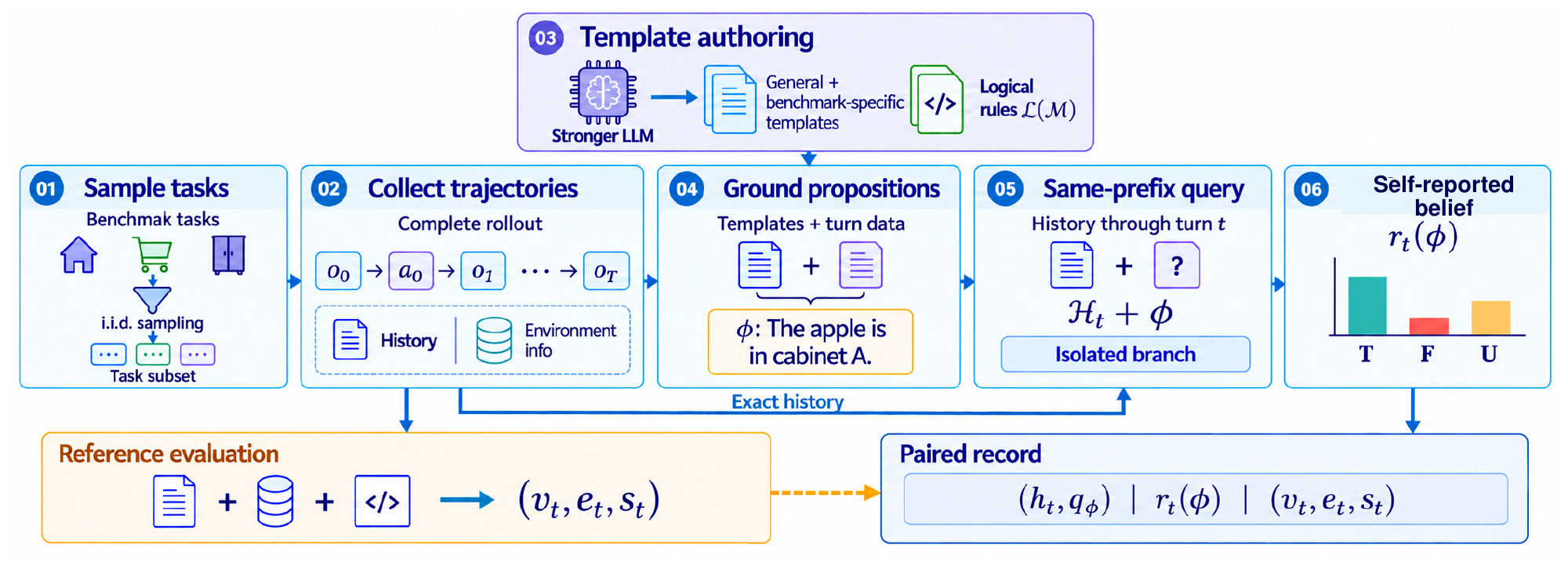
图 1.数据流程。对采样任务收集智能体轨迹,将 LLM 生成的命题模板与逻辑规则逐轮实例化;在同一记录前缀下查询模型的自报告信念,再与参考评估模块给出的标签和概率配对。
查看原图 ↗摘要
Large language models (LLMs) are increasingly deployed as autonomous agents in interactive environments that require multi-step planning, reasoning, and state tracking. Evaluating an agent’s beliefs about environment states and task progress can therefore help diagnose behavioral failures. However, reference belief labels are often unavailable or difficult to obtain. In this paper, we introduce a general, LLM-assisted evaluation pipeline that combines proposition generation with reference labels. The pipeline grounds LLM-authored proposition templates in agent trajectories and obtains labels from an LLM-assisted reference observer using formal logical rules and Bayesian inference. Using this pipeline, we systematically evaluate models’ self-reported belief consistency and accuracy across World, Epistemic, Affordance, and Decision propositions in ALFWorld, WebShop, and Noisy Cabinets and examine their relationship with task success. T/F-only Affordance and Decision accuracy are positively associated with task success after centering within environments. Furthermore, we find that response tendencies help explain both observed consistency and accuracy variation: the tendency to answer Unknown contributes to cross-model differences in consistency, and a True/False tendency model explains degradation in accuracy and negation consistency as context grows.
主要方法与贡献
- 构建 LLM 辅助的评估流程,将命题模板实例化到智能体交互轨迹中,并结合形式逻辑规则与贝叶斯推断,生成真/假/未知三类参考标签。
- 在 ALFWorld、WebShop 和 Noisy Cabinets 中评估世界状态、认知状态、行动可行性与决策四类命题,同时衡量准确率及选项排列、否定、时序与改写一致性。
- 发现当参考标签与模型回答均为真或假时,行动可行性与决策命题的准确率在环境内中心化后仍与任务成功率正相关,体现出对智能体行为的诊断价值。
- 揭示回答“未知”的倾向是不同模型一致性差异的来源之一,并建立回答倾向模型,联系准确率与否定一致性,解释二者随交互历史增长而下降的现象。