Linear Readability Does Not Guarantee Writability: Evidence from Controlled Counterfactual Recomposition
Can directions that accurately decode a model's internal state also steer its decisions when that state changes?
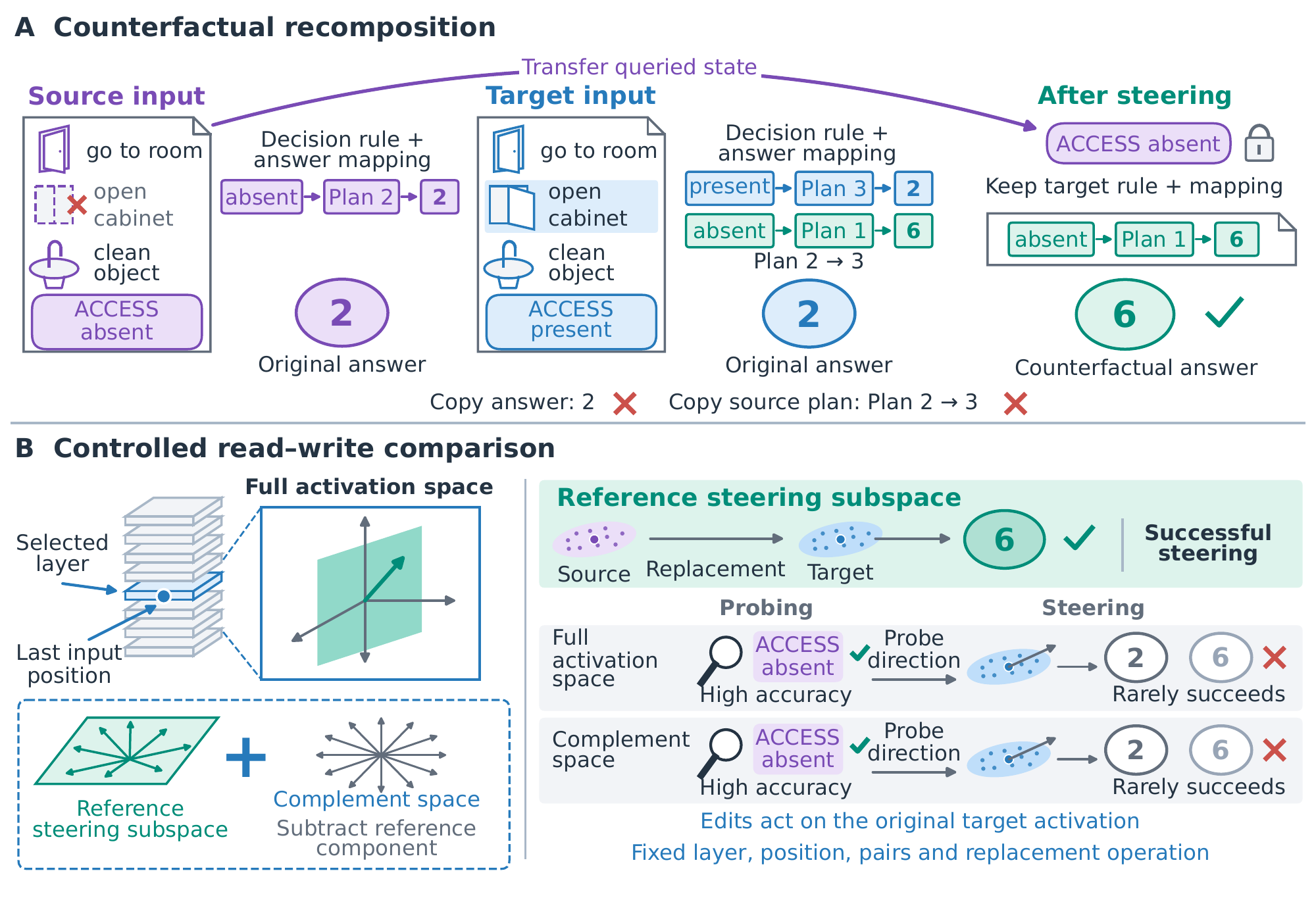
Figure 1. Controlled counterfactual recomposition and the read–write comparison. (A) Combining the source state with the target rule and answer mapping requires answer 6; copying an original answer or the source plan instead yields 2 or 3. (B) State information remains readable outside a validated steering subspace, but direct probe directions rarely support the required recomputation under the same intervention conditions.
View full-size figure ↗Abstract
Linear probing reveals information encoded in large language models, but whether probe-derived directions can reliably steer model decisions remains unclear. To investigate this question, we carefully design a controlled experiment on tasks constructed from ALFWorld and WebShop trajectories, whose action lists allow us to define explicit state changes and determine the corresponding answers. In the experiments, we combine the source input’s queried state with the target input’s decision rule and answer mapping, which we term counterfactual recomposition, to test whether steering supports the intended recomputation rather than merely copying an answer or source plan. Simultaneously, we learn and validate a reference steering subspace to ensure that steering can produce the required counterfactual answer at the selected location. This reference enables a controlled comparison with probe-derived steering in the complement space under fixed intervention conditions. Across four models and both environments, probing accuracy remains near-perfect in the complement space, while steering with direct probe directions, covariance-transformed directions, or combinations of multiple probe directions achieves near-zero counterfactual recomposition accuracy. These results reveal a critical finding: high readability alone does not guarantee writability through probe-derived interventions even with effective steering available, which provides valuable insight for developing reliable steering methods.
Methods and contributions
- Constructed controlled tasks from ALFWorld and WebShop trajectories that combine a source input's state with a target input's decision rule and answer mapping, distinguishing counterfactual recomputation from answer or source-plan copying.
- Learned and validated a reference steering subspace to establish that the required answer change is achievable, then compared probe-derived interventions at the same layer and position with fixed sample pairs and replacement operation.
- Across four models and both environments, found near-perfect linear probing accuracy in the orthogonal complement of the reference subspace, while direct probe-derived steering achieved near-zero counterfactual recomposition accuracy.
- Tested covariance-transformed directions and combinations of multiple probe directions; their gains in the full activation space did not carry over to the complement, showing that high probing accuracy alone is insufficient evidence of effective steering.